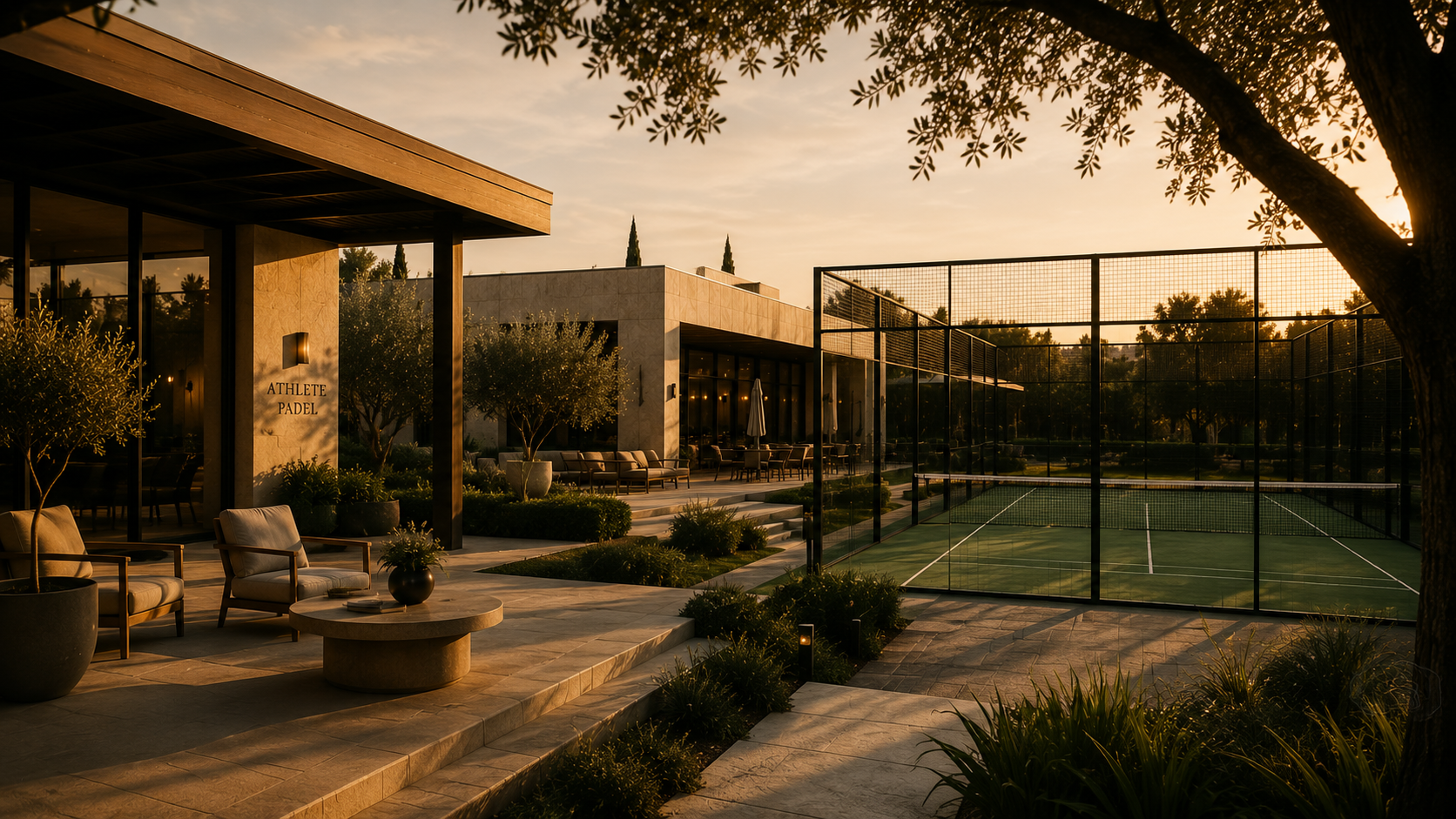
What makes one of the world’s best padel clubs? It is tempting to start with court count, professional specifications or the names who have played there. Those things matter. But a truly exceptional club creates a stronger memory: the arrival, the architecture, the people, the drink after the game and the feeling that the court belongs exactly where it is.
This is not a ranking of the biggest padel centres in the world. It is the Athlete Padel edit of clubs and venues that represent where the culture of the sport is going in 2026.
1. Puente Romano Tennis & Padel Club — Marbella, Spain
Puente Romano remains a defining reference for the relationship between racquet sport and luxury hospitality. The club currently has four padel courts alongside ten tennis courts and sits within the wider Puente Romano Beach Resort on Marbella’s Golden Mile. Its history includes major tennis and padel events, but the real appeal is the setting: sport is integrated into an established resort ecosystem rather than treated as a separate amenity.
Why it makes the edit: heritage, hospitality and one of Europe’s most recognisable padel destinations.
2. Reserve Miami Design District — Miami, USA
Reserve’s Design District location takes the private-club model seriously. The members-only venue has three glass-enclosed courts, a viewing lounge and pro shop, alongside an outdoor gym, cold plunge, showers and members’ lounge. Reserve membership also includes priority booking and curated events across its network.
Why it makes the edit: a clear vision of padel as a membership and social experience.
3. Reserve Miami Seaplane — Miami, USA
The Seaplane location is a different proposition: five glass-enclosed courts across a large waterfront site, with viewing and lounge areas and a setting that feels unmistakably Miami. It demonstrates the power of place. The courts could exist elsewhere, but the experience could not.
Why it makes the edit: setting, scale and visual identity.
4. Padel Haus — New York, USA
Padel Haus helped establish the premium indoor padel model in New York and now operates across multiple US cities. Its clubs pair professional-grade courts with cafes, pro shops, fitness areas, coworking and lounges, while programming includes open play and private events.
Why it makes the edit: one of the strongest examples of an urban padel club becoming part of city culture.
5. Padium — Canary Wharf, London
Padium’s stated ambition is not simply to build a padel facility but to build a culture around it. In Canary Wharf, that translates into premium panoramic courts, lounge and bar space, coaching, match analysis and carefully considered service details. London’s padel market is expanding quickly, but Padium stands out because it understands that experience is the differentiator.
Why it makes the edit: design, performance and a coherent club identity.
6. Padel Edition — Dubai, UAE
Padel Edition describes itself as a place to perform and recharge, and the facility makes that tangible: eight indoor courts alongside contrast recovery, wellness and studio space. In a climate where indoor padel is especially valuable, the club uses that functional requirement as the starting point for something much more polished.
Why it makes the edit: wellness and padel designed as one experience.
7. Padel Islands — Dubai, UAE
There are clubs with more courts and clubs with more amenities. There are very few where the court itself is the story. Padel Islands operates two floating padel courts on the lake at JLT, surrounded by Dubai’s skyline. It is playful, visual and memorable — and a reminder that padel can create destination experiences that go far beyond traditional club design.
Why it makes the edit: originality and one of the most distinctive settings in the sport.
8. The Glen Country Club — Cape Town, South Africa
The Glen Country Club sits between Clifton and Camps Bay with a dramatic Cape Town backdrop. Its padel offer includes three courts alongside the wider country club, clubhouse and sporting facilities. What elevates it is not a technological feature or enormous court inventory; it is the sense of place.
Why it makes the edit: a setting that makes the journey worthwhile before the first ball is hit.
The Athlete Padel standard
We look for five things when considering the world’s best padel clubs: court quality, atmosphere, hospitality, community and sense of place. A club does not need to be private, expensive or enormous to qualify. It does need a point of view.
That distinction will matter more as padel continues to scale. The global sport is growing quickly, and hundreds of new venues can make “premium” a meaningless label if every new club uses the same language. The places that endure will be those that feel specific to their city, community and setting.
Court quality is assumed. Taste is the differentiator.
Discover the Collection
Explore more considered places to play in the Athlete Padel Collection, browse destinations around the world, or join Athlete Padel. Clubs interested in being considered can use the Club tab on the Join page.
Club information
Puente Romano · Reserve Padel · Padel Haus · Padium · Padel Edition · Padel Islands · Glen Country Club